 KI
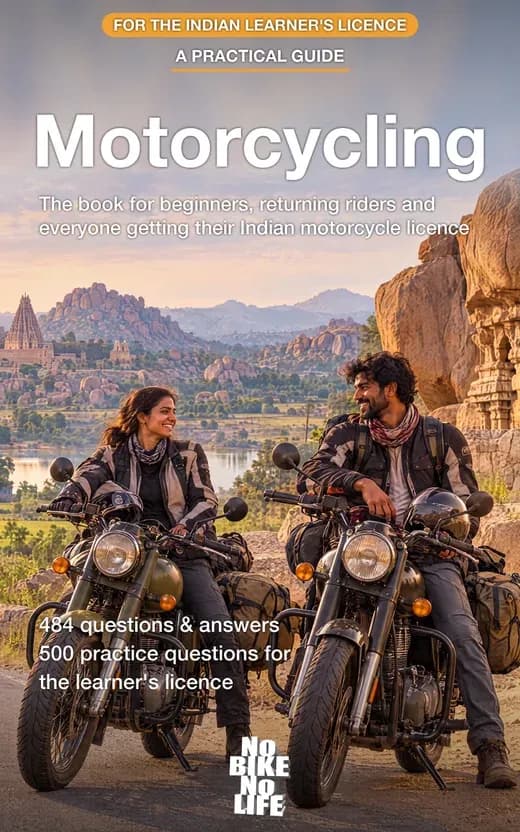
KIMotorcycling
The book for beginners, returning riders and everyone getting their Indian motorcycle licence
Di cosa parla
Testo originale dell’edizione, in ingleseThe Indian edition — written for the Motor Vehicles Act, 1988 and the rules made under it.
You dream of riding, but a thousand questions hold you back? That is exactly what this book is for: honest, on a first-name basis and with a special eye on women getting into riding. It takes you from your first time in the saddle through protective gear, riding physics and cornering technique to a passed learner's licence test — and beyond, when those first kilometres turn into real journeys.
Three parts that work independently of one another:
- Part I — Beginner Questions. Around 90 major topics with 484 detailed answers to the questions you really ask yourself at the start: Why doesn't the bike fall over? How do I survive my first hill start? What do I have to wear, and what's just marketing?
- Part II — The learner's licence test. 500 practice questions, arranged along the four subjects that rule 11 of the Central Motor Vehicles Rules, 1989 lays down: traffic signs, signals and the driving regulations; what a rider must do after an accident; the precautions at an unmanned railway level crossing; and the documents to carry. Plus the motorcycle-specific chapters the car books skip — braking, cornering, filtering, monsoon, night riding, carrying a pillion.
- Part III — nbnl.net. A guide to the online community: catalogue, adviser, route planner, Best Tracks, licence trainer and garage.
Test yourself honestly. Each question comes with its answer options first and the solution with its reasoning after it — so you can think it through before you look.
Up to date with the Motor Vehicles (Driving) Regulations, 2017. The driving rules made under section 118 were rewritten in 2017 and amended in 2020; the old Rules of the Road Regulations of 1989 no longer apply. This edition teaches the current rules, including the ones that changed for riders: the three cases in which you may overtake on the left; when lane splitting is allowed at all (only in urban areas on roads with a 40 km/h limit, where a sign permits it, and at no more than 15 km/h faster than the traffic); why a two-wheeler may not be towed; dipped headlights in daytime; 25 km/h past signed schools, hospitals and construction sites; and carrying your documents in electronic form.
Two things this book does that others don't. It tells you where central law ends and your State begins: the pass mark of 60 per cent is fixed by rule 11, but the number of questions your Regional Transport Office puts to you is not — and under section 210A every fine in the Act is multiplied by a figure your State chooses, between one and ten. Every rupee figure in this book is the central base figure, and the book says so each time. And it cites its sources: each question names the section, rule or regulation it comes from.
Independent learning and practice work. No connection to, and neither endorsed nor approved by, the Ministry of Road Transport and Highways, any State Transport Department or Regional Transport Office, the Bureau of Indian Standards or the Indian Roads Congress. The questions are independently written from the Motor Vehicles Act, 1988, the Central Motor Vehicles Rules, 1989 and the Motor Vehicles (Driving) Regulations, 2017 — they are not the questions asked at any Regional Transport Office. Passing is not guaranteed. Legal position as at October 2026.
Anteprima
22 pagine dal libro impaginato: copertina, occhiello e frontespizio, l’indice completo e le prime pagine di tutte e tre le parti. Si sfoglia con le frecce, con la tastiera o scorrendo: nessun download, nessuna registrazione.
In breve
Motorcycling è l’edizione inglese del libro di moto NBNL per l’India (inglese indiano). Si basa su Motor Vehicles Act 1988 · CMVR 1989 · Motor Vehicles (Driving) Regulations 2017 e non è una traduzione: domande, cifre e unità seguono le norme di questo mercato. La brossura porta l’ISBN 979-8-17637364-6, la copertina rigida l’ISBN 979-8-17637400-1. Questa edizione non è ancora stata pubblicata. È un’opera di esercitazione indipendente e non contiene le domande ufficiali d’esame.
Parole chiave
Le parole chiave dell’edizione, così come figurano nei suoi dati bibliografici.
Domande e risposte
In che lingua è «Motorcycling» e per quale paese vale?
«Motorcycling» è scritto in inglese ed è pensato per l’India. Lì valgono Motor Vehicles Act 1988 · CMVR 1989 · Motor Vehicles (Driving) Regulations 2017. L’edizione non è la traduzione di un’altra: domande, cifre e unità seguono le norme di quel mercato. L’edizione è impaginata, verificata e provvista di ISBN: manca solo l’apertura della vendita.
Che ISBN ha «Motorcycling»?
La brossura porta l’ISBN 979-8-17637364-6, la copertina rigida l’ISBN 979-8-17637400-1. L’e-book non ha ISBN: il negozio gli assegna un identificativo proprio (un ASIN).
Quante pagine ha «Motorcycling»?
brossura 479 pagine, copertina rigida 459 pagine. La differenza viene dalla gabbia più ampia della copertina rigida, non da contenuti in più: i due formati contengono lo stesso libro.
In quali formati esiste «Motorcycling»?
Tutti e tre i formati — e-book, brossura e copertina rigida — sono impaginati e verificati. Nessuno è ancora pubblicato: le edizioni a stampa portano il loro ISBN, manca solo l’apertura della vendita.
«Motorcycling» contiene le domande ufficiali d’esame?
No. È un’opera di esercitazione indipendente, senza legami con gli enti d’esame o con gli editori dei cataloghi ufficiali di domande. Le domande sono formulate in proprio e il superamento dell’esame non è garantito.
C’è un’anteprima di «Motorcycling»?
Sì, 22 pagine da sfogliare direttamente su questa pagina, senza download e senza registrazione. Comprendono la copertina, l’indice completo e le prime pagine di ciascuna delle tre parti: domande da principiante, catalogo di domande per la patente e la comunità online.