 KI
KIMotorcycling
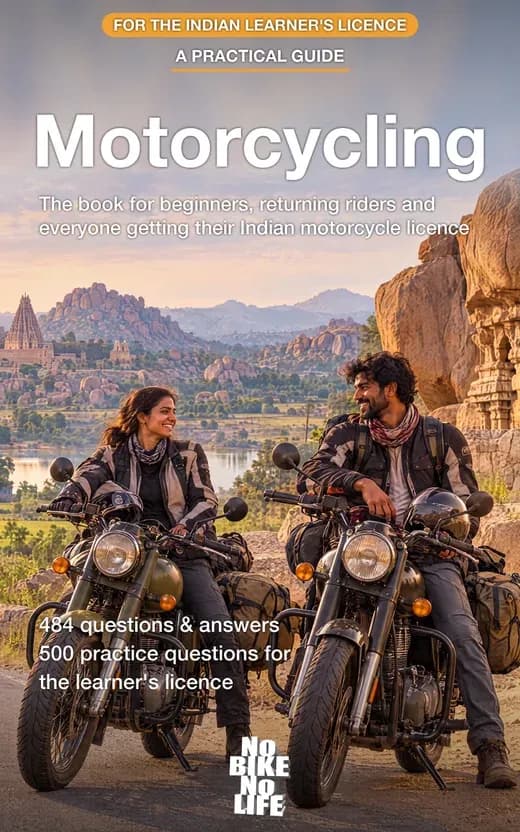
The book for beginners, returning riders and everyone getting their Indian motorcycle licence
De quoi il s’agit
Texte original de l’édition, en anglaisThe Indian edition — written for the Motor Vehicles Act, 1988 and the rules made under it.
You dream of riding, but a thousand questions hold you back? That is exactly what this book is for: honest, on a first-name basis and with a special eye on women getting into riding. It takes you from your first time in the saddle through protective gear, riding physics and cornering technique to a passed learner's licence test — and beyond, when those first kilometres turn into real journeys.
Three parts that work independently of one another:
- Part I — Beginner Questions. Around 90 major topics with 484 detailed answers to the questions you really ask yourself at the start: Why doesn't the bike fall over? How do I survive my first hill start? What do I have to wear, and what's just marketing?
- Part II — The learner's licence test. 500 practice questions, arranged along the four subjects that rule 11 of the Central Motor Vehicles Rules, 1989 lays down: traffic signs, signals and the driving regulations; what a rider must do after an accident; the precautions at an unmanned railway level crossing; and the documents to carry. Plus the motorcycle-specific chapters the car books skip — braking, cornering, filtering, monsoon, night riding, carrying a pillion.
- Part III — nbnl.net. A guide to the online community: catalogue, adviser, route planner, Best Tracks, licence trainer and garage.
Test yourself honestly. Each question comes with its answer options first and the solution with its reasoning after it — so you can think it through before you look.
Up to date with the Motor Vehicles (Driving) Regulations, 2017. The driving rules made under section 118 were rewritten in 2017 and amended in 2020; the old Rules of the Road Regulations of 1989 no longer apply. This edition teaches the current rules, including the ones that changed for riders: the three cases in which you may overtake on the left; when lane splitting is allowed at all (only in urban areas on roads with a 40 km/h limit, where a sign permits it, and at no more than 15 km/h faster than the traffic); why a two-wheeler may not be towed; dipped headlights in daytime; 25 km/h past signed schools, hospitals and construction sites; and carrying your documents in electronic form.
Two things this book does that others don't. It tells you where central law ends and your State begins: the pass mark of 60 per cent is fixed by rule 11, but the number of questions your Regional Transport Office puts to you is not — and under section 210A every fine in the Act is multiplied by a figure your State chooses, between one and ten. Every rupee figure in this book is the central base figure, and the book says so each time. And it cites its sources: each question names the section, rule or regulation it comes from.
Independent learning and practice work. No connection to, and neither endorsed nor approved by, the Ministry of Road Transport and Highways, any State Transport Department or Regional Transport Office, the Bureau of Indian Standards or the Indian Roads Congress. The questions are independently written from the Motor Vehicles Act, 1988, the Central Motor Vehicles Rules, 1989 and the Motor Vehicles (Driving) Regulations, 2017 — they are not the questions asked at any Regional Transport Office. Passing is not guaranteed. Legal position as at October 2026.
Extrait
22 pages du livre composé : couverture, pages de titre, la table des matières complète et les premières pages des trois parties. Tournez les pages avec les flèches, les touches fléchées ou en balayant — sans téléchargement ni inscription.
En un coup d’œil
Motorcycling est l’édition anglaise du livre moto NBNL pour l’Inde (anglais indien). Elle s’appuie sur Motor Vehicles Act 1988 · CMVR 1989 · Motor Vehicles (Driving) Regulations 2017 et n’est pas une traduction : questions, chiffres et unités suivent le droit de ce marché. Le broché porte l’ISBN 979-8-17637364-6, le relié l’ISBN 979-8-17637400-1. Cette édition n’est pas encore parue. C’est un ouvrage d’entraînement indépendant : il ne contient pas les questions officielles de l’examen.
Mots-clés
Les mots-clés de l’édition, tels qu’ils figurent dans ses données bibliographiques.
Questions et réponses
En quelle langue est « Motorcycling » et pour quel pays vaut-il ?
« Motorcycling » est écrit en anglais et conçu pour l’Inde. Le droit applicable y est Motor Vehicles Act 1988 · CMVR 1989 · Motor Vehicles (Driving) Regulations 2017. Cette édition n’est la traduction d’aucune autre : questions, chiffres et unités suivent le droit de ce marché. L’édition est composée, vérifiée et pourvue de son ISBN — la vente n’est simplement pas encore ouverte.
Quel est l’ISBN de « Motorcycling » ?
Le broché porte l’ISBN 979-8-17637364-6, le relié l’ISBN 979-8-17637400-1. Le livre numérique n’a pas d’ISBN — la boutique lui attribue son propre identifiant (un ASIN).
Combien de pages compte « Motorcycling » ?
broché 479 pages, relié 459 pages. La différence vient de la justification plus large du relié, pas d’un contenu supplémentaire — les deux formats contiennent le même livre.
Dans quels formats existe « Motorcycling » ?
Les trois formats — numérique, broché et relié — sont composés et vérifiés. Aucun n’est encore paru : les éditions imprimées portent leur ISBN, la vente n’est simplement pas ouverte.
« Motorcycling » contient-il les questions officielles de l’examen ?
Non. C’est un ouvrage d’entraînement indépendant, sans lien avec les autorités d’examen ni avec les éditeurs des catalogues officiels de questions. Les questions sont rédigées de façon indépendante, et aucune réussite à l’examen n’est garantie.
Existe-t-il un extrait de « Motorcycling » ?
Oui, 22 pages à feuilleter directement sur cette page — sans téléchargement ni inscription. On y trouve la couverture, la table des matières complète et les premières pages de chacune des trois parties : questions de débutant, catalogue de questions du permis et la communauté en ligne.