Ducati Desmo450 EDS 2026: The first enduro with a number plate
First road-legal Ducati enduro – what the service intervals and price mean
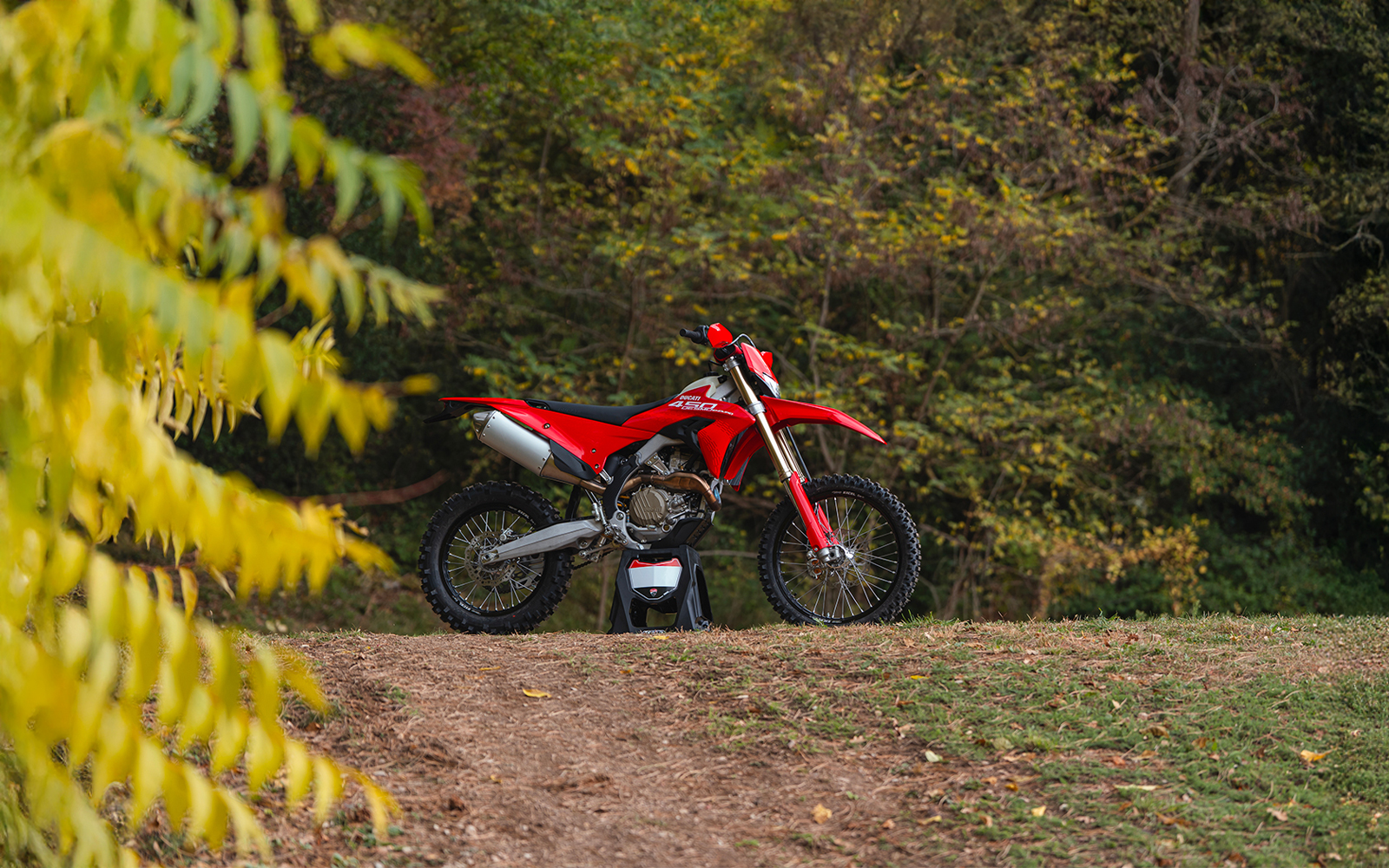
In 2026, Ducati is presenting the first road-legal enduro in the brand's history: the Desmo450 EDS. We take a look at what the short service intervals, the still undisclosed price and the comparison with the competition really mean.
It was only a matter of time. After Ducati entered motocross in 2024 with the Desmo450 MX, the logical continuation now follows: the Desmo450 EDS, Ducati's first road-legal enduro. Today, 9 June 2026, it has officially been unveiled – fittingly in the anniversary year marking the 100th birthday of the brand from Borgo Panigale.
And yes, it looks damn good. Sharp lines, the LED headlight in superbike style, plus that unmistakable red. Visually, this thing makes a statement. But we wouldn't be NBNL if we didn't look beyond the glossy images – and there are two points you should consider before pre-ordering.
What's inside
The basis is the Desmo450 MX motocross bike, carefully modified for off-road use. The aluminium perimeter frame houses the liquid-cooled 449.6 cm³ single-cylinder engine with – of course – desmodromic valve actuation. This makes the EDS the only enduro bike in its class with desmodromic valves, meaning without conventional valve springs. Ducati has not yet finally confirmed the exact performance figures for the road version; as a guide, the engine produces around 63 hp in the competition models.
What distinguishes the EDS from the pure motocross bike:
- Six-speed gearbox instead of five, with a shorter first and longer sixth gear – a wider spread for tours and technical sections.
- 8.5-litre tank, transparent and integrated into the frame, so you can keep an eye on the fuel level. 1.3 litres more than the MX.
- 21"/18" tyres with Metzeler Six Days Extreme – classic enduro sizes.
- More softly tuned Showa suspension (49 mm fork, 310 mm travel), co-developed with enduro world champion Antoine Meo.
- Standard protection pack: handguards, engine protection, more robust aluminium covers.
The full electronics package – traction control (DTC), launch control, quickshifter, engine brake control – is available only with the optional Racing Kit. There is less included as standard than the marketing images suggest.
Key issue 1: The service intervals – and why you need to put them into context correctly
Ducati markets its “adaptive maintenance” as an innovation: an algorithm calculates an engine load index based on your riding style and adjusts the intervals in the X-Link app. Sounds clever – and it is. The basic figures are:
- Piston replacement: every 90 operating hours (extendable to 120 via the app)
- Valve clearance check: every 180 operating hours (up to 240)
- Complete engine overhaul: after 180 to 240 hours
That sounds like a lot of workshop time. A scheduled piston replacement as a regular service item – that is unusual at first. But before we write it off: what are we actually comparing it with? Because “road-legal enduro” is not a uniform category. There are two fundamentally different families.
Family 1 – Racing enduros with number plates. Detuned competition engines with lighting: KTM EXC-F, Husqvarna FE, Beta RR, Yamaha WR. High-revving, lightweight, maintenance-intensive – servicing by operating hours, with the piston a wear item. This is where the EDS belongs.
In this league, the Ducati is no exception – quite the opposite. The 90 hours for the piston are exactly on Beta level and only slightly shorter than KTM. When it comes to valve clearance, the EDS is actually clearly better at 180 hours than a KTM EXC-F, which already wants checking after around 30 hours. The adaptive X-Link system extends this further for recreational riders. So within its class, the EDS is surprisingly well positioned.
Family 2 – Adventure and dual-sport enduros. Honda CRF450L, KTM 690 Enduro, and in a broader sense Ducati's own DesertX. Conventional long-life engines, servicing by kilometres, with the piston lasting the life of the engine. The Honda CRF450L, for example, wants fresh oil every 1.000 km, a valve check every 3.000 km – and an engine overhaul only at 30.000 km. No piston replacement based on hours. A recreational rider can go for years without opening up the engine in a major way.
And that is exactly where the problem lies: anyone who unconsciously puts the red-painted EDS into family 2 – “it's a road-legal enduro, I'll use it for everything” – will be caught out by the running costs. Anyone who takes it for what it is – a competition machine with a number plate – will find the intervals completely normal.
In practical terms, this means that an ambitious recreational enduro rider doing 50 to 100 hours a year will be at the dealer with a piston due roughly every year. That is the price of the spectacle – with Ducati just as much as with KTM or Beta.
Key issue 2: The price (which nobody knows yet)
To be honest, this is where things become unclear at market launch. Ducati has not yet stated an official list price – the product page only refers to “available for pre-order” and “contact dealer”. For context: the standard Desmo450 MX starts at 12.490 Euro, while the MX Factory starts at 14.590 Euro. The more elaborate, road-legal EDS is unlikely to come in below that.
My tip: wait for the official price announcement before letting a pre-order form rush you. With a machine whose planned running costs already consume pistons, you want to know the total bill, not just the showroom price.
Who is it for?
The EDS is clearly aimed at the ambitious sport enduro rider who wants a sharp, lightweight competition machine with a number plate – and for whom maintenance effort and purchase price are secondary. Anyone looking for tours, long stages and predictable running costs is better served by the DesertX.
If you fit into the first category: congratulations, Ducati is finally building your toy. If not: stay relaxed, have a look at it at the dealer, and don't let the red paint blind you.
Available from July 2026 at selected European Ducati off-road dealers, initially only in Ducati Red.
Note: Ducati communicates the road approval inconsistently – the product page clearly describes the EDS as the first approved Ducati enduro, while the press release carries the addition “not approved for public road traffic” (presumably referring to the Racing Kit version). We will update this as soon as the final homologation data are available.
Conclusion
My impression: the Desmo450 EDS is exactly the toy hardened Ducatisti have been waiting for – beautiful, sharp, with the typical Desmo character. But nobody should mistake it for a low-maintenance adventure enduro: the annual piston is part of the concept, not a scandal. Anyone who knows that and still goes for it gets an honest competition machine with a number plate. Anyone looking for one enduro for everything will be more relaxed with the DesertX – and spend less on running costs. You will get our final verdict as soon as Ducati puts the price and homologation data on the table.