Getting there safely
starts with a question.
488 honest answers for your start — from the first thought about a licence to your first tour. Plain-spoken, completely free.
Your knowledge, chapter by chapter
Choose the chapter on the left, open all the questions on the right and read at your own pace — like a good handbook.
Understanding the basics
Why it moves, how it brakes, shifts, steers
 KI
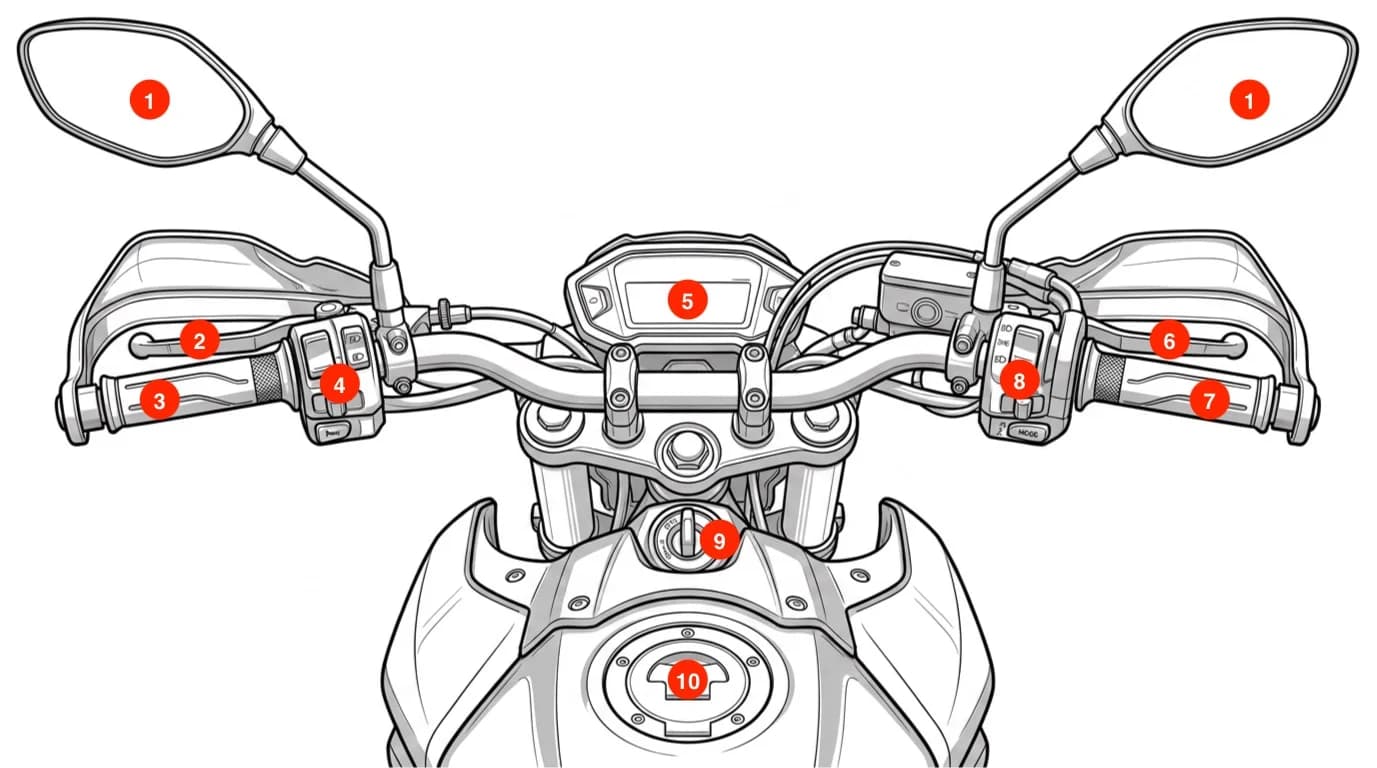
KIThe controls on the handlebars — the view from the saddle.
- Mirrors — left and right
- Clutch lever
- Left handlebar grip
- Left-hand handlebar switches — turn signals, horn, headlight flasher and high beam
- Display / speedometer
- Front brake lever
- Throttle
- Right-hand handlebar switches — kill switch and starter button
- Ignition lock, doubles as the steering lock
- Fuel cap
Almost everything you need while riding is within reach of your hands — the picture shows the view from the saddle, and the numbers turn up again in the legend below it.
Left hand: the clutch lever (2) and the switch unit (4) with turn signals, horn and headlight flasher. Right hand: the throttle (7), the front brake lever (6) and the switch unit (8) with the kill switch and starter button. In the middle: display (5), ignition lock (9) and fuel cap (10). The mirrors (1) are adjusted before every ride.
One rule of thumb makes the start easy: clutch on the left, throttle and front brake on the right. What your feet operate — gear lever on the left, rear brake pedal on the right — sits outside the picture; more on that in . The layout is the same on almost every motorcycle, only the shape and labelling of the switches differ.
Your knowledge, chapter by chapter
Understanding the basics
Why it moves, how it brakes, shifts, steers
KIThe controls on the handlebars — the view from the saddle.
- Mirrors — left and right
- Clutch lever
- Left handlebar grip
- Left-hand handlebar switches — turn signals, horn, headlight flasher and high beam
- Display / speedometer
- Front brake lever
- Throttle
- Right-hand handlebar switches — kill switch and starter button
- Ignition lock, doubles as the steering lock
- Fuel cap
Almost everything you need while riding is within reach of your hands — the picture shows the view from the saddle, and the numbers turn up again in the legend below it.
Left hand: the clutch lever (2) and the switch unit (4) with turn signals, horn and headlight flasher. Right hand: the throttle (7), the front brake lever (6) and the switch unit (8) with the kill switch and starter button. In the middle: display (5), ignition lock (9) and fuel cap (10). The mirrors (1) are adjusted before every ride.
One rule of thumb makes the start easy: clutch on the left, throttle and front brake on the right. What your feet operate — gear lever on the left, rear brake pedal on the right — sits outside the picture; more on that in . The layout is the same on almost every motorcycle, only the shape and labelling of the switches differ.
What others started with
A1: from age 16, up to 125 cc and 15 hp. A2: from age 18, up to 48 hp (regardless of engine size). A: from age 24 directly (or from age 20 after holding A2 for 2 years), with no limit. With the NBNL licence trainer you can practise specifically for each class.
All the knowledge to take with you
 KI
KIAll the knowledge to take with you
All 488 beginner questions — plus the real licence test questions for A1, A2 and A. Curated and sorted: read offline, give as a gift, keep on the shelf.
Look inside
22 pages to leaf through — no download, no sign-upReady for the licence test?
You now know the most important beginner questions — the next step is the test. Practise the real test questions for A, A1 and A2 — completely free.